
Contact us

Mag. Ursula Hillbrand


AoH-Salonhosting GmbH


UID ATU 72239909
Firmenbuchnummer: 470589v Feldkirch
IBAN AT23 3700 0000 0500 2373
BIC RVVGAT2B

Team Development | Collaborative Work | Organisational Development

Communities of Practice – Powerful Collaboration in Organisations, Online & Offline

Communities of Practice bring knowledge, experience and shared learning to life in organisations and are the best remedy for organisations who want to stop working in silos.

Communities of Practice

“Communities of Practice are groups of people who share a concern or a passion for something they do and learn how to do it better as they interact regularly.”
– Etienne Wenger

Ursula Hillbrand supports organisations in building Communities of Practice that connect people, strengthen collaboration across organisational units and make change sustainable over time.

From individual trainings or projects, a learning culture can emerge that continues to have an impact in everyday work. Communities of Practice can be developed both online and in person, depending on the organisation, context and purpose.

What is a Community of Practice?

A Community of Practice is a community of people connected by a shared field of practice or competence, a common concern or a professional challenge. They are indispensable for organisations who want to drive sustainable change and innovation carried by all levels.

They meet regularly to exchange experience, learn from one another and further develop their practice.

Unlike a classical project team, a Community of Practice does not only work towards one specific result or a defined end date. It also creates an ongoing space for reflection and knowledge exchange.

In this way, especially implicit knowledge becomes usable that would otherwise often remain hidden in individual minds, departments or projects.
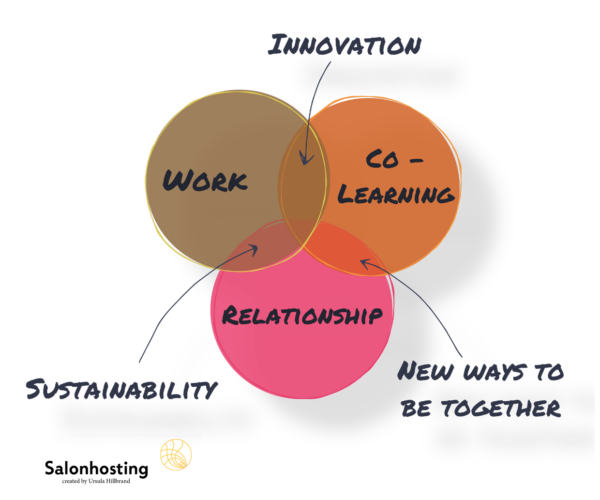
Why Communities of Practice Enable Sustainable Change

Sustainable change rarely emerges from one-off interventions. It emerges where people learn together over time, reflect on experience and test new practices in everyday work.

Communities of Practice create a framework for exactly this. They connect people who work on similar questions, often across different roles, departments or organisational units. They foster exchange of knowledge within the organisation and enable sustainable team development.

For a Community of Practice to have a lasting impact, it needs a shared purpose, committed people, trust, a safe space and skilled process guidance.

When these elements come together, exchange can become a self-sustaining learning culture.

    How Ursula Hillbrand Supports Communities of Practice

    Ursula Hillbrand supports Communities of Practice not as a rigid programme, but as a living development process for collaborative work.

    At the centre is the question: What does this organisation need so that collaboration, learning and knowledge exchange can succeed over time?

    Founding & Kick-off of a CoP

    The starting point is clarifying the shared purpose.

    Why should this community be created? Who should be involved? Which field of practice connects the people? How is the core group formed? Which formats help build trust? Sometimes an already existing network can be transformed in a community of practice.

    Ursula designs kick-off formats where participants develop a shared understanding, identify relevant questions and establish first agreements for collaboration.

    Support & Process Design

    At the beginning, a Community of Practice needs structure, rhythm and good formats.

    Ursula supports the development process through suitable dialogue formats, reflection spaces, process designs and methodological impulses.

    She pays attention to participation, role clarity and the balance between openness and commitment.

    Transfer into Self-Organisation

    The aim of good support is a community that increasingly carries itself.

    People take responsibility, develop their own formats, share knowledge and continue to shape their practice together.

    Ursula’s distinguishing strength lies precisely in this transition: she supports Communities of Practice in such a way that external support becomes less necessary over time.

    Which Organisations Benefit from This?

    Communities of Practice are suitable for organisations that do not only want to manage knowledge but keep it alive and applied by all who need it.

    • They are particularly valuable in transformation processes, cross-departmental collaboration or complex professional fields.
    • They are suitable for companies, public administrations, universities, NGOs, international organisations and networks.
    • Teams that want to secure implicit knowledge over the long term, develop new roles or anchor change in everyday practice also benefit from a well-supported Community of Practice.
    • Communities of Practice can be designed as in-person, online or hybrid formats, depending on the organisational context and the people involved.

      Reference Projects

      Communities of Practice become effective where experience, specialist knowledge and collaboration need to be connected over longer periods of time.

      Selected reference projects show how Ursula Hillbrand has built, supported or methodologically strengthened Communities of Practice in different contexts.

      Powerful Collaboration Meets Art of Hosting

      Communities of Practice work particularly well when they are not only introduced organisationally, but consciously hosted.

      Good questions, dialogic formats and clear process architecture help trust and shared collective learning to emerge.

      Ursula Hillbrand connects Communities of Practice with Art of Hosting, systems thinking and many years of experience in participatory organisational development.

      This creates a living practice that people can carry forward themselves.

        Learning to Facilitate Communities of Practice Yourself – the Salonhosting Academy

        Your benefits for CoP with Salonhosting:

        · Organisations can commission Ursula Hillbrand directly to build and support a Community of Practice.

        · At the same time, internal staff members can learn to host, facilitate and cultivate Communities of Practice themselves over the long term.

        The Salonhosting Academy offers deepening learning spaces for this. People who take responsibility for learning culture, collaboration or transformation develop methodological confidence and process competence there.

        Voices from Practice

        The impact of Communities of Practice is not only visible in individual results, but in a changed quality of collaboration.

        People share knowledge more openly, learn from one another and develop a stronger sense of shared responsibility.

        Here, testimonials from organisations show how Communities of Practice sustainably strengthen learning, trust and cross-departmental collaboration.

        George Pòr
        George Pòr
        President at Campus Co-Evolve
        “As our client in the European Commission, her dedication to create a warm and safe space of authentic human relations in a highly hierarchical workplace, and generate a continually increasing value to both the organization and community members, was the biggest factor in accomplishing our mission.”
        Arch. DI Daniel Fügenschuh
        Arch. DI Daniel Fügenschuh
        President of the Architect’s Council of Europe (ACE)
        “Our goal was to enable a dialogue and exchange among experts across borders. We succeeded brilliantly, despite or perhaps because of the online format, under the highly competent leadership of Ursula Hillbrand and her team, we succeeded brilliantly. Our participants actively contributed throughout the day and stayed in the digital aperitif rooms for a cultivated exchange, like at a face-to-face conference. We are exited.”
        Dr. Ronald de Bruin
        Dr. Ronald de Bruin
        Director of COST Association, European Cooperation in Science and Technology
        “The moment I walked in as a director of the COST Association, I knew I wanted to make this an even more innovative organisation. Networks of researchers need networked leadership. After a training on designing and leading participatory meetings we booked Ursula for helping us towards excellency on the ground. We now have a wonderful community of practice supporting each other’s needs, and we are skilled not only in hosting participatory meetings to instill engagement and ownership in its participants but also do that with souvereignty online. A big thank you! Ronald de Bruin was appointed Director of the COST Association in June 2016. Before joining the Association, he was Director of the European Institute of Innovation and Technology (EIT) and Head of Department of the European Network and Information Security Agency (ENISA).”

          Would you like to build, further develop or guide a Community of Practice into self-organisation within your organisation or across organisational boundaries?

          Ursula Hillbrand supports you in creating a sustainable framework for knowledge exchange, collective learning and powerful collaboration.

          Resources

          Further Information on Communities of Practice:

          • Wenger-Trayner, E., Wenger-Trayner, B., Reid, P., & Bruderlein, C. (2023). Guidebook: Communities of practice within and across organizations. Social Learning Lab
          • Wenger-Trayner, E. & Wenger-Trayner, B. 2015: An Introduction to Communities of Practice. wenger-trayner.com/introduction-to-communities-of-practice
          • Wenger, E., White, N., Smith, J.D., 2009: Digital Habitats: Stewarding Technology for Communities
          • Lave, J. & Wenger, E. 1991: Situated Learning: Legitimate Peripheral Participation. Cambridge University Press.
          • Tuckman, B. W. 1965: Forming-Storming-Norming-Performing. Original article in Psychological Bulletin.
          • Senge, P. 1990: The Fifth Discipline. Doubleday.

          FAQ – Communities of Practice

          What is a Community of Practice?

          A Community of Practice is a community of people connected by a shared field of practice or a shared concern. They meet regularly to exchange experience, learn from one another and further develop their practice.

          What is the difference between a Community of Practice and a project team?

          A project team usually works towards a concrete goal and a defined end point. A Community of Practice is designed for the longer term. It supports continuous learning, knowledge exchange and the development of shared practice.

          What are the three core elements of a Community of Practice according to Wenger?

          A Community of Practice consists of three core elements: a shared domain or field of practice, a community of people learning together, and a shared practice that is developed through exchange, experience and application.

          What does learning organisation mean?

          A learning organisation reflects on experience, shares knowledge and develops through collective learning. Communities of Practice can be an important building block for this because they anchor learning in everyday work.

          What does a Community of Practice need in order to function over the long term?

          It needs a clear shared purpose, committed participants, trust, regular meetings, good questions and suitable process support. Over time, it should be strengthened in such a way that it can organise itself.

          How does a Community of Practice foster knowledge exchange within a company?

          It creates a space in which people can share experiences, questions, mistakes, solutions and implicit knowledge. In this way, knowledge is not only documented but passed on and further developed as a living practice.

          How does Ursula Hillbrand support the development of a Community of Practice?

          Ursula Hillbrand supports organisations in clarifying the shared purpose, designing the kick-off, developing the process design, facilitating the first formats and supporting the transition into self-organisation. The aim is a Community of Practice that is carried from within over the long term.

          Salonhosting Copyright Ursula Hillbrand – all rights reserved